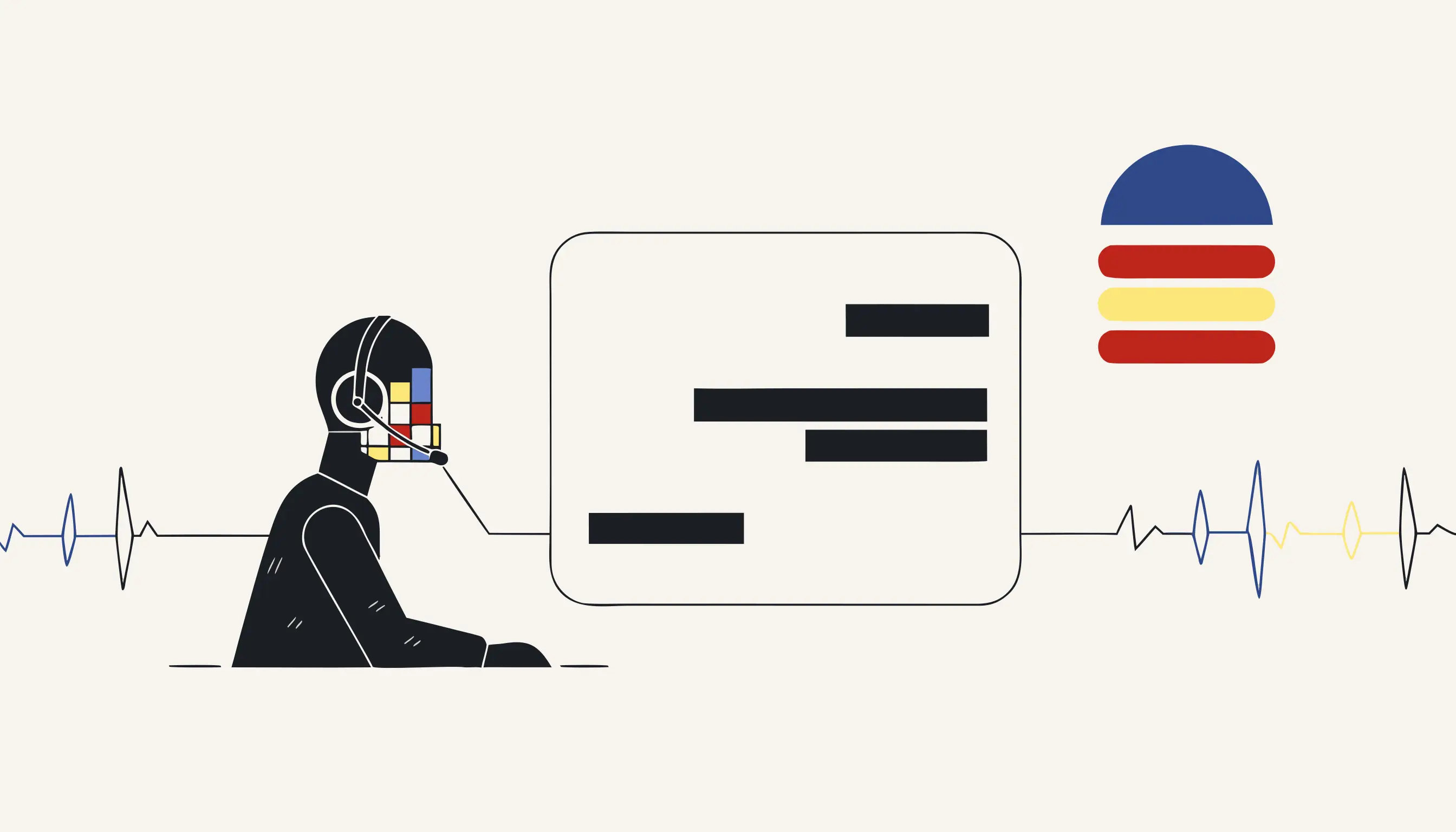
A single customer call can be a compliance time bomb. The customer reads out a 16-digit card number, then the CVV, spells their surname, confirms their home address and reels off an account ID, all while the recording runs. Multiply that by thousands of calls a day across a contact center, and you are storing a searchable archive of exactly the data regulators care about most.
This guide explains how to redact PII from call recordings at scale: how to handle PCI-DSS card data, names and addresses; when to use a beep versus silence; how to keep recordings useful for QA and analytics; and how to design a pipeline that is irreversible, auditable and GDPR-aligned rather than a manual bottleneck.
TL;DR
- Call recordings routinely capture PCI-DSS card data, names, addresses and account IDs, all of which must be removed before the audio is stored, shared or analyzed.
- The reliable pattern is two steps: locate the sensitive moments (transcription with timestamps + entity detection), then redact them deterministically on the waveform with a beep or silence.
- A beep gives an audible audit trail (best for PCI and legal); silence is cleaner for QA and analytics datasets. Both are irreversible when applied correctly.
- You can redact a call recording right now without an account: upload, choose what to remove, and download a clean copy.
What call-center recordings actually leak
Support and sales calls are unstructured conversations, which makes them far riskier than a tidy database column. The personal data is not in a labeled field; it is spoken naturally, mid-sentence, scattered across minutes of dialogue.
The recurring categories you have to plan for:
- Payment card data (PCI-DSS scope): the Primary Account Number (PAN), expiry date and CVV. The CVV is sensitive authentication data and must never be retained after authorization. The PAN must be protected wherever it lives, including audio.
- Direct identifiers: full names, spelled-out surnames, dates of birth, email addresses.
- Contact and location data: phone numbers, home and billing addresses, postcodes.
- Account and reference numbers: customer IDs, order numbers, IBANs, national ID numbers.
The hard part is not knowing what to remove; it is finding where each item appears across a high-volume archive, and removing it in a way you can prove later. That is a pipeline problem, not a manual one.
What "redaction" really means for audio
Redacting a call is not muffling the voice, lowering the volume or flagging the file for review. It means identifying every spoken piece of personal data and destroying it in the recording so it cannot be recovered.
Two distinct jobs hide inside that sentence:
- Locating the sensitive information: knowing the exact time range where a card number or address is spoken.
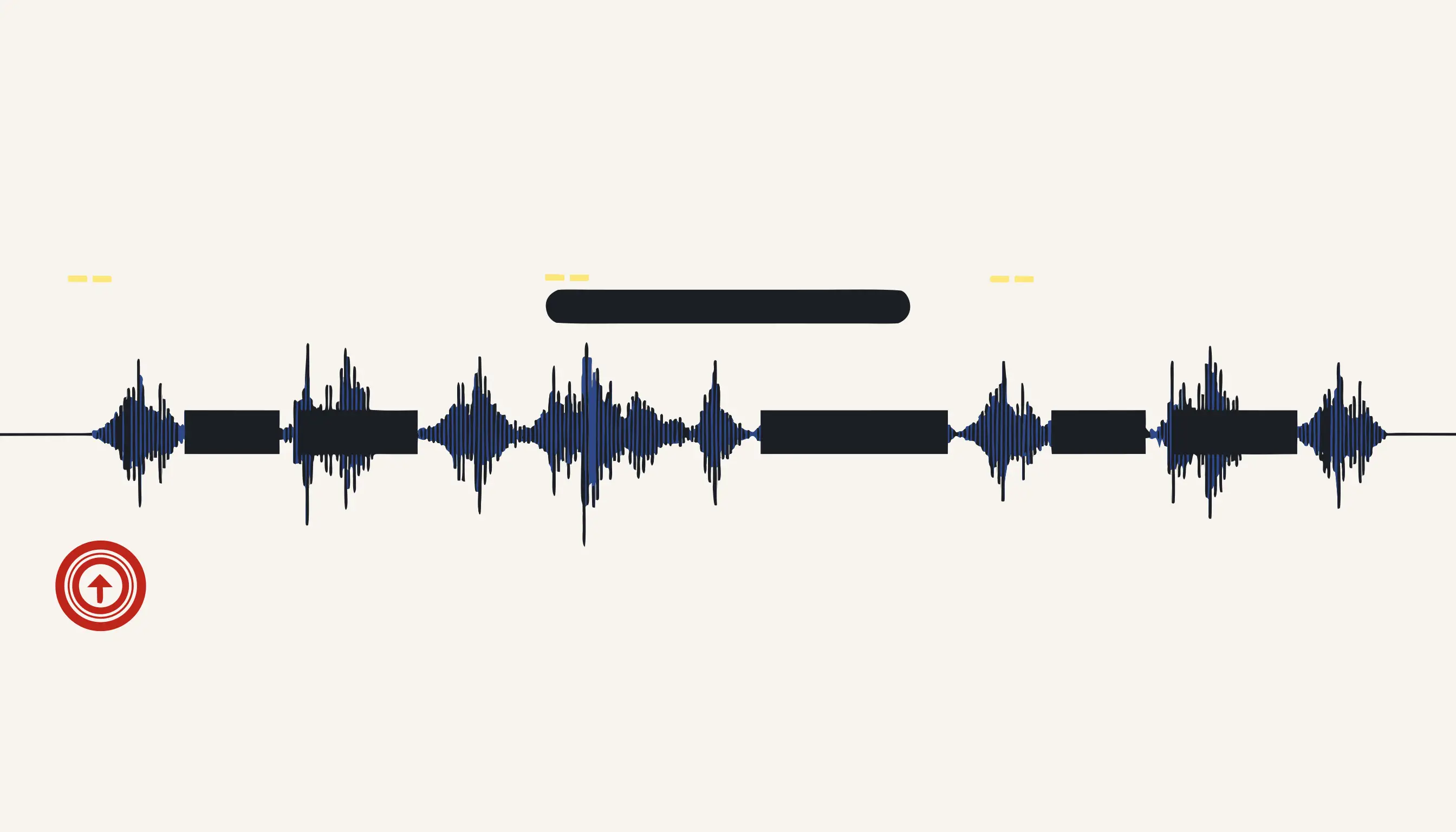
- Removing it: replacing that precise range with a beep or silence on the waveform.
Confusing these steps is the most common (and most dangerous) mistake. Locating benefits from AI (speech-to-text and entity recognition). Removing must never be left to a model: it has to be deterministic code operating on exact timestamps, because that is what makes the result reproducible, testable and trustworthy. The same principle applies to every medium, as covered in how to anonymize audio recordings.
Designing the pipeline: locate, then redact
A scalable redaction pipeline separates the probabilistic part (finding PII) from the deterministic part (destroying it). Here is the shape that holds up under volume and audit.
Step 1: Locate with a timestamped transcript
You cannot redact what you cannot find. Transcribe each call to text with word-level timestamps using a speech-to-text model with alignment (WhisperX-style). Every word gets a start and end time.
Then detect PII over that transcript with two complementary techniques:
- Named-entity recognition (NER) flags people, organizations and locations: the names and addresses.
- Regex plus checksum validation catches structured identifiers. A card number is only redacted if it passes the Luhn check, so a real PAN is removed while a random 16-digit string spoken in conversation is left alone. The same logic applies to IBANs and national IDs.
This stage produces only a map of time ranges to redact. Nothing is changed yet, which means you can review and adjust before any audio is touched.
Step 2: Redact deterministically on the waveform
Map each sensitive word back to its timestamp and apply the redaction directly to the samples, typically with a tool like ffmpeg. Because it is a direct cut-and-replace, the original speech in those ranges is gone. There is no hidden layer, no key, nothing to peel back.
Step 3: Strip metadata and log the operation
Audio files carry metadata (timestamps, device info, sometimes agent IDs). Strip it during re-encoding. Then write an audit log: which file, which categories were detected, how many redactions, and the method used. This is what turns a one-off edit into a defensible, repeatable process.
PCI-DSS: the card-data problem
Card data deserves its own treatment because the rules are explicit and the penalties are real.
- The CVV / CVV2 is sensitive authentication data. PCI-DSS prohibits storing it after authorization, full stop. If your recordings capture it, those segments must be redacted (or the recording must not be retained).
- The PAN must be rendered unreadable wherever it is stored. In audio, "unreadable" means the spoken digits are physically destroyed, not masked behind a tag.
A common architectural pattern is pause-and-resume recording: the platform stops the recording while the customer enters or reads card data, then resumes. That works for live capture, but it does nothing for your existing archive of recordings that already contain card numbers. For that backlog, and for any call where pause-and-resume failed, waveform redaction with checksum-validated detection is the remediation.
| Data type | PCI-DSS handling | Redaction approach |
|---|---|---|
| CVV / CVV2 | Never retain after authorization | Beep (audible audit trail) |
| PAN (card number) | Render unreadable when stored | Beep, validated by Luhn check |
| Expiry date | Protect alongside PAN | Beep or silence |
| Cardholder name | Personal data (GDPR) | Beep or silence |
Beep vs. silence: which to choose
Both beep and silence are irreversible when applied to the waveform. The choice is about audit visibility versus listening experience.
| Method | Best for | Trade-off |
|---|---|---|
| Beep | PCI, legal, compliance, QA (where you must show a redaction happened) | Slightly more intrusive to listen to |
| Silence | Analytics, AI training data, internal datasets | Can be mistaken for a recording dropout |
| Both (beep over silence) | Maximum clarity and auditability | Marginally more processing |
For regulated contact-center data, beep is the safer default: it leaves an audible marker that something was intentionally removed, which is exactly what an auditor wants to hear. Reserve silence for downstream analytics datasets where a clean listening experience matters more than the audit trail.
Keeping recordings useful for QA and analytics
The fear that redaction "ruins" the recording is misplaced. Because only the sensitive time ranges are replaced, everything else is untouched and re-encoded losslessly where possible. What survives is exactly what QA and analytics teams need:
- Agent tone, empathy and script adherence for quality scoring.
- Sentiment and intent signals for analytics and conversation intelligence.
- The full conversation structure, minus the handful of seconds where PII was spoken.
This is what makes redaction an enabler rather than a blocker. A redacted archive can be shared with offshore QA teams, fed into speech analytics, or used to fine-tune models, none of which would be permissible on the raw recordings. For deeper background on retaining versus pseudonymizing, see anonymization vs. pseudonymization.
Why AI should locate but not remove
It is tempting to hand the whole call to a model and ask it to "return the redacted audio." Don't. Generative editing is non-deterministic. Run it twice and you may get two different outputs, with no guarantee that every card number was caught.
The reliable pattern keeps the boundary clean:
- AI locates (transcription + entity detection): a task models are genuinely good at.
- Deterministic code removes (timestamp → beep/silence, regex + Luhn, metadata stripping): a task that must be exact, testable and identical every time.
This is how Medianonymizer approaches every media type: the model only points at sensitive data; plain code does the destruction. The output is precise, reproducible and the same every run.
Is a redacted call truly irreversible?
Yes, provided you redact on the waveform rather than overlaying a marker or editing metadata. Replacing samples with a beep or silence destroys the original signal in those ranges. There is no key, no hidden track, no way to reconstruct the removed speech.
This is the line between anonymization and pseudonymization. Pseudonymization swaps identifiers for reversible tokens; with the key, the data comes back. Anonymization removes it for good, which is what can take a recording out of the scope of regulations like the GDPR. For how this fits an enterprise control framework, see data anonymization for enterprise compliance.
A practical checklist
Before you consider a call recording redacted, confirm:
- Every spoken card number, CVV, name, address and account ID has a corresponding redaction.
- Card numbers were validated with a Luhn check (real PANs removed, random digits left alone).
- Redactions are applied to the waveform, not as a separate overlay or tag.
- The method (beep or silence) matches your audit needs: beep for PCI and legal.
- File metadata was stripped during re-encoding.
- An audit log records what was detected, removed and how.
- The result was reviewed: automated detection plus a human spot-check on a sample.
Redact your call recordings now
You don't need to build this pipeline from scratch. Upload a call recording, tell the assistant what to remove (card data, names, addresses) and download a clean copy where every sensitive moment is beeped or silenced, irreversibly. The AI only locates the PII; deterministic code destroys it, so the result is auditable and the same every time.
Frequently asked questions
Yes. PCI-DSS prohibits storing sensitive authentication data (like the CVV) after authorization, and the PAN must be protected wherever it is stored. If your call recordings capture customers reading card numbers aloud, those segments must be redacted or the audio must not be retained at all.