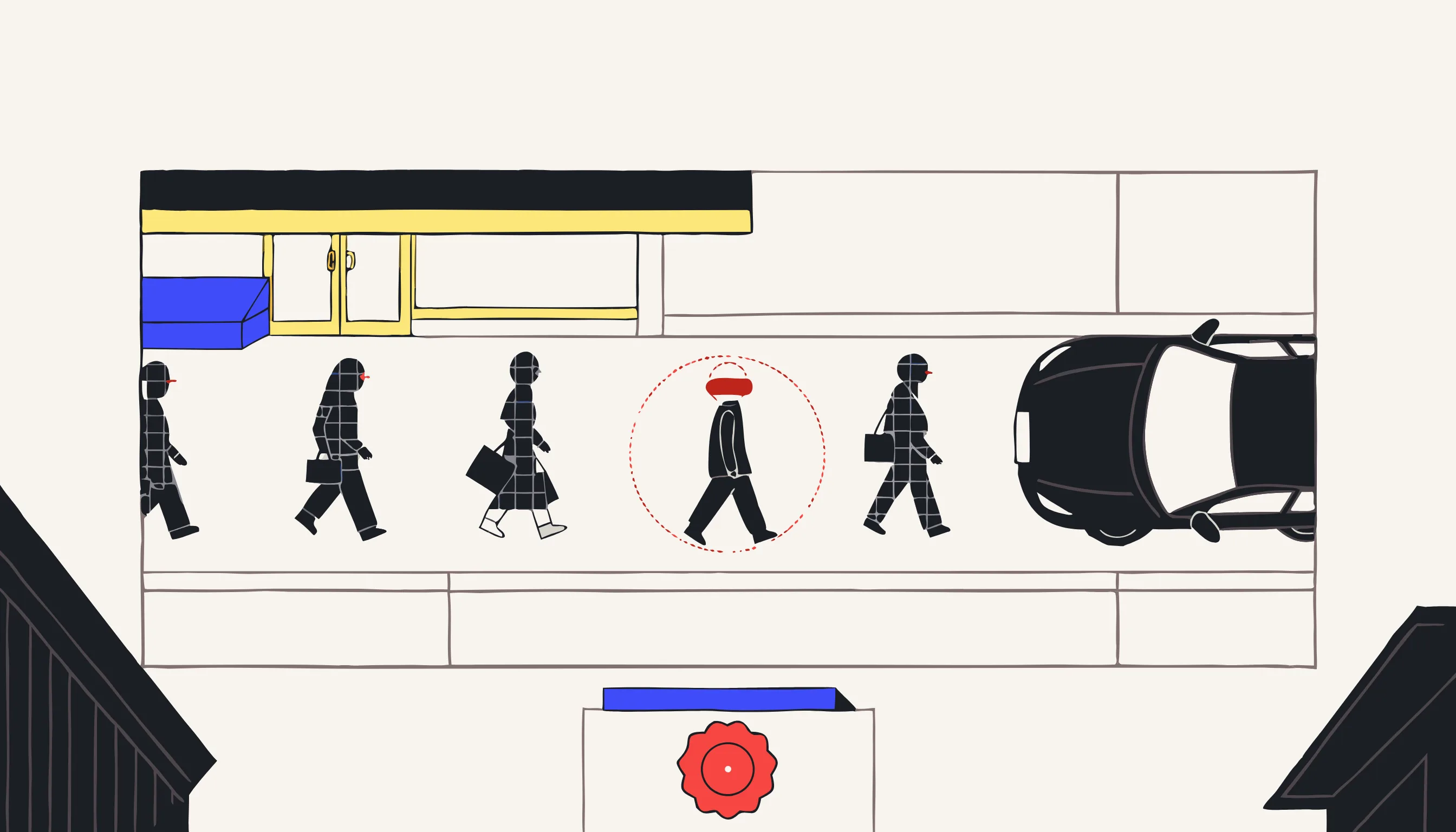
Surveillance footage is evidence, and a privacy liability at the same time. A single CCTV clip from a store entrance can be decisive in a dispute or investigation, but it also captures dozens of uninvolved bystanders: their faces, their license plates, sometimes badges or documents in plain view. The moment you need to share that footage (with opposing counsel, in a public-records request, or in a transparency release), you have to remove everyone who isn't part of the matter while keeping everything that makes the video probative.
This guide explains how to anonymize CCTV and surveillance footage properly: how to blur bystanders without destroying evidentiary value, how to keep the redaction irreversible, and how to maintain the chain of custody and auditability that legal and FOIA contexts demand.
TL;DR
- Anonymizing surveillance footage means selectively blurring identifying details (bystander faces, license plates, badges) while preserving the actions, timing and context that make the clip useful as evidence.
- The reliable workflow is two steps: locate identifying regions per frame, then redact them deterministically by destroying the pixels (not overlaying a shape).
- Chain of custody matters as much as the blur: hash the original and output, log every action, and keep the process reproducible so the result holds up legally.
- You can redact a surveillance video right now: upload, mark what to blur, and download an irreversibly anonymized copy.
Why surveillance footage is a special case
Most anonymization tasks let you remove sensitive data and move on. Surveillance evidence is different: you are working with material that may have legal weight, where what you keep matters as much as what you remove.
Two competing obligations pull against each other:
- Privacy and data minimization: bystanders captured incidentally have a right not to be identifiable in a release. Under the GDPR and most public-records frameworks, you may only disclose what is necessary.
- Evidentiary integrity: courts, regulators and journalists need to trust that the footage shows what actually happened. Over-redact, and the clip becomes meaningless; alter the timeline, and you destroy its credibility.
The job, then, is surgical: blur the identifying details of uninvolved people while leaving the scene, the sequence of events and the timestamps untouched.
What "anonymizing CCTV" actually means
Anonymization is not lowering resolution or pixelating the whole frame. For surveillance video it means identifying every region that makes an uninvolved person identifiable and destroying that visual information, frame by frame, so it cannot be recovered.
There are two distinct jobs hiding in that sentence:
- Locating the identifying regions: knowing where in each frame a bystander's face or a plate appears, and tracking it as it moves.
- Removing it: replacing those exact pixel regions with an irreversible blur or solid box.
Confusing these two steps is the most common and most dangerous mistake. The "locating" part benefits from AI (face detection, object tracking). The "removing" part must never be left to a model. It has to be deterministic code operating on precise coordinates, because that is what makes the result reproducible, testable and defensible in front of a court.
Step 1: Locate identifying regions across frames
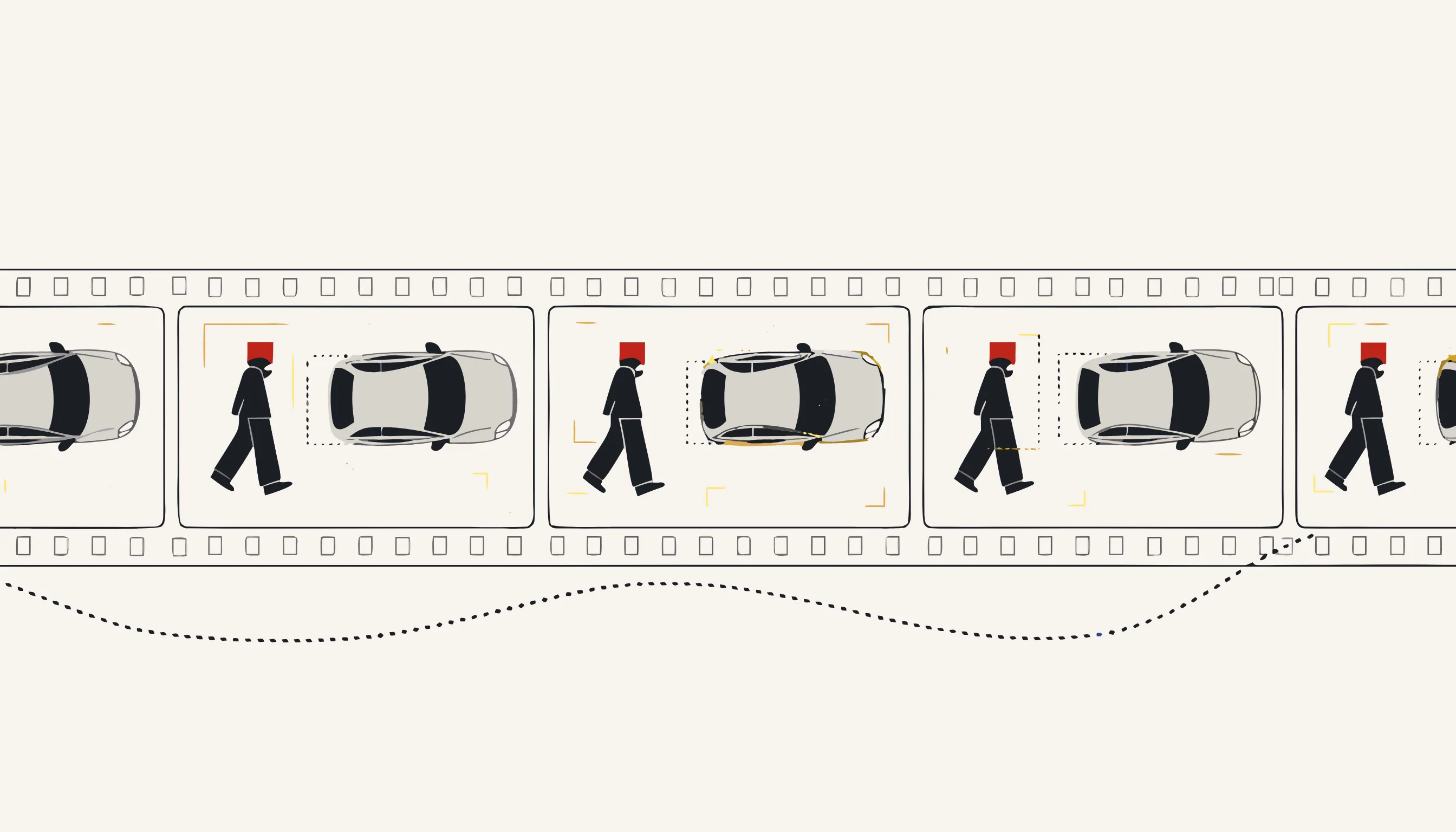
You can't redact what you can't find, and in video the target keeps moving. Detection has to run per frame and the results have to be tracked so a face that walks across the scene stays redacted in every frame it appears.
Detection typically covers:
- Faces → face-detection models flag every face, including partial and angled ones common in overhead CCTV.
- License plates → object detection locates plates on vehicles passing through.
- Other identifiers → badges, name tags, screens or documents visible in frame can be flagged as regions to redact.
This stage produces only a map of regions and time ranges to blur. Nothing in the video is changed yet. Just as important: it should produce nothing that touches the timestamps or frame order, because altering those would undermine the footage as evidence.
Keep the people who matter
In evidence work you often need to keep specific individuals visible (the parties to the incident) while blurring everyone else. A good workflow lets you exclude regions from redaction, so the subject of the investigation stays clear and the surrounding bystanders are anonymized.
Step 2: Redact deterministically by destroying pixels
Now you map each region back to its coordinates and apply the redaction directly to the frames. This is a deterministic operation, applied to the actual video samples:
- Blur: replace the region with a heavy Gaussian blur so detail is unrecoverable.
- Solid box: replace the region with a filled rectangle, the most absolute option, useful when even the silhouette must go.
Because the operation re-encodes those pixels, the original detail in those regions is gone. There is no hidden layer to peel back.
Blur vs. box vs. overlay
| Method | Best for | Trade-off |
|---|---|---|
| Gaussian blur (re-encoded) | Most FOIA and legal releases: obvious redaction, preserves scene context | Heavy blur required; light blur can be reversed |
| Solid box (re-encoded) | Maximum certainty: even posture or silhouette must be hidden | Removes more context than necessary |
| Overlay shape (NOT recommended) | Nothing: looks redacted but isn't | Original pixels remain underneath; trivially reversible |
The overlay trap is worth calling out: a black rectangle drawn on top of an untouched video is not redaction. Anyone can strip the overlay and recover the original frames. Real anonymization re-encodes the pixels so the underlying data ceases to exist.
Why AI should locate but not remove
It is tempting to hand the whole clip to a model and ask it to "return the anonymized video." Don't. Generative editing is non-deterministic. Run it twice and you may get two different results, with no guarantee every face was caught, and worse, it can hallucinate or alter the actual content of evidence.
The reliable pattern separates concerns:
- AI locates (face detection + tracking): a task models are genuinely good at.
- Deterministic code removes (coordinates → blur/box, then re-encode): a task that must be exact, testable and repeatable.
This is exactly how Medianonymizer approaches every media type: the model only points at sensitive regions; plain code does the destruction. The result is precise, auditable and the same every time, which is precisely what a chain of custody requires.
Chain of custody and auditability
For surveillance evidence, how you anonymized is as important as the result. A blur you cannot account for is a liability. Build an auditable trail:
- Hash the original before any processing (e.g., SHA-256) and record it.
- Keep the original under access control: never overwrite it; the redacted copy is a derivative.
- Log every redaction: what regions, what method, who initiated it, when.
- Hash the output so its integrity can be verified later.
- Use a deterministic process so the same input reliably produces the same output; reproducibility is what makes the method defensible.
- Preserve timestamps and frame order: never re-time or re-cut the evidentiary content.
Because the redaction is deterministic and irreversible, the output is GDPR-aligned for release while the original remains available, under control, for the parties entitled to it. If you want the deeper principles behind this, see irreversible, auditable anonymization best practices.
Is anonymized footage truly irreversible?
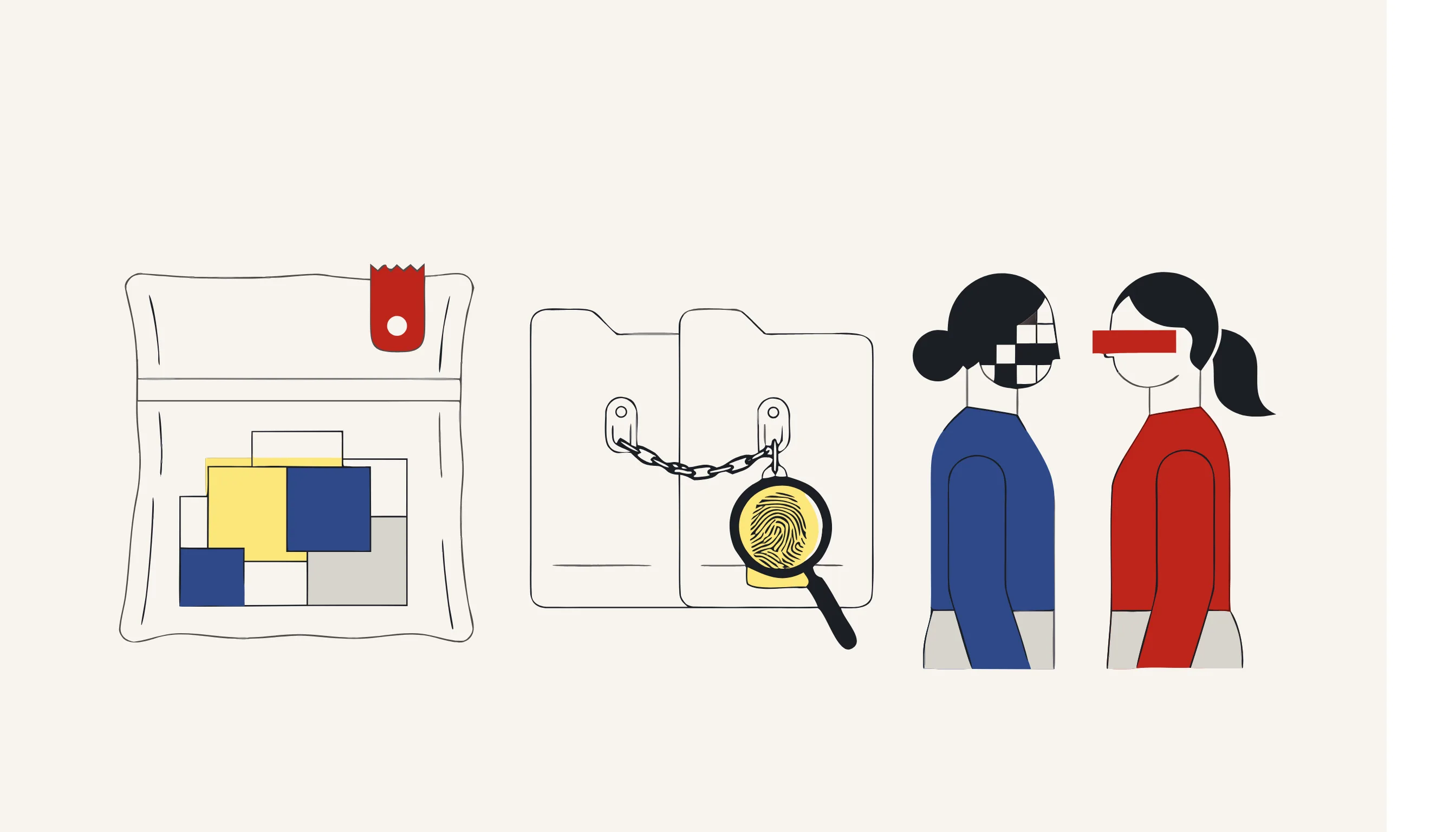
Yes, if you redact by re-encoding the pixels rather than overlaying a shape or marking metadata. Replacing a region with a heavy blur or a solid box destroys the original visual signal there. There is no key, no hidden track and no way to reconstruct the removed detail.
This is the difference between anonymization and pseudonymization. Pseudonymization swaps identifiers for reversible tokens; with the key, the data can be restored. Anonymization removes the data for good, which is what takes a release out of scope of regulations like the GDPR. If you need the distinction in detail, see anonymization vs. pseudonymization.
Don't forget the file itself, either: surveillance exports often carry metadata: camera ID, GPS, device serials, recording software tags. Stripping that metadata is part of a complete redaction, the same way it matters for images.
Common use cases
- Legal evidence disclosure: share CCTV with opposing counsel while blurring uninvolved bystanders, keeping the incident itself fully visible.
- FOIA and public-records releases: police body-cam and municipal CCTV released to the public with faces and plates redacted.
- Transparency and press: newsrooms publishing surveillance clips that protect bystander identity.
- Insurance and HR investigations: review footage with non-parties anonymized to respect data minimization.
A practical checklist
Before you consider a surveillance video anonymized, confirm:
- Every bystander face and license plate is blurred in every frame it appears.
- Redactions are re-encoded into the pixels, not drawn as an overlay.
- The people who must stay visible (the parties) are intentionally preserved.
- Timestamps, frame order and the scene itself are unchanged.
- File metadata (camera ID, GPS, serials) has been stripped.
- The original is hashed, access-controlled and retained per policy; the output is hashed for integrity.
- The result was reviewed: automated detection plus a human spot-check.
Anonymize your surveillance footage now
You don't need to build this pipeline yourself. Our CCTV footage anonymizer runs the whole redaction for you. Upload a CCTV or surveillance file, mark the faces to remove (and the people to keep), and download an anonymized copy where every identifying region is irreversibly pixelated, with an auditable, deterministic process behind it.
Frequently asked questions
Yes. Selective blurring targets only faces, license plates and other identifying details, leaving the actions, timing and context that give the footage its evidentiary value fully intact. The key is redacting regions, not whole frames, and never altering the underlying timeline or timestamps.